Why a Hotel Restaurant Needs to Feel Independent From the Hotel
Hotel restaurant branding has one job that most brand work doesn’t: making a venue feel like it has nothing to do with the hotel. Hotel guests are a captive audience, so it’s tempting to lean on them. But the restaurants and bars people book on purpose, tell friends about and cross town for tend to feel like places in their own right, not a service on the hotel’s floor plan.
The lobby problem
When a restaurant wears the hotel’s logo, colours and typeface, guests read it as an amenity, like room service with tablecloths. They eat there because it’s convenient. Anyone not staying assumes it isn’t for them. Compare that with the best restaurants and bars in any city: they look nothing like their landlord, and nobody asks who owns the building.
What independent actually means
It means the venue has its own name, not “The [Hotel] Restaurant”. Its own identity: logo, palette, typography, illustration. Its own voice, right down to the menu copy. Its own presence at the door, so a passer-by sees a place with a point of view rather than a hotel department. The hotel is still there, but quietly: an endorsement line, the booking details, the standards that sit behind the scenes.
What the hotel should still control
Independence isn’t a free-for-all. The parent brand protects what has to be protected: service and safety standards, how the venue is endorsed, where the hotel name sits and when it’s used. It doesn’t dictate colours, type or personality. A clear frame with a free picture inside it is what lets a venue feel confident without feeling disconnected.
Two Hanoi venues, one hotel
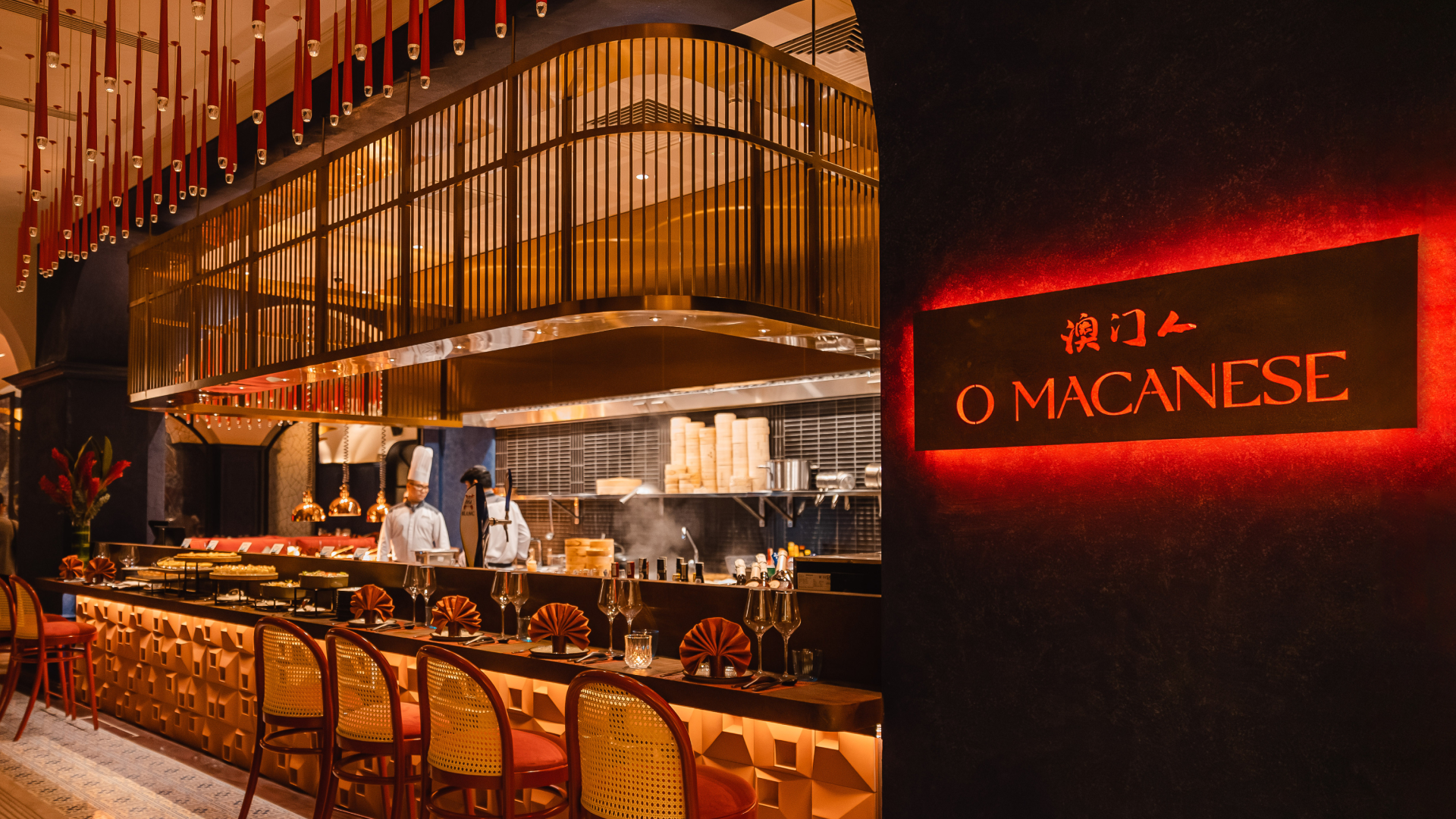
O Macanese is built on Macanese food: Portuguese cooking after four hundred years in southern China. The identity had to show that collision to a guest walking past an open kitchen, in about a second, so we made it a wall. A hand-painted dragon coils across a black arch drawn in Chinese temple style, its body filled with a blue-and-white pattern that belongs equally to Ming ceramics and Portuguese azulejo tile. Engraved illustrations and red neon signage carry the same three colours and one illustration style. It’s a restaurant with its own story, and the hotel isn’t part of it. See the full O Macanese restaurant branding case study.
Cabana Club is a poolside bar on the hotel roof, asked to feel like Miami’s South Beach. The wordmark takes its shape from moving water, the palette is neon brights built to hold up after dark, and a loud collage-style visual language runs through signage, menus and collateral across both the clubhouse and poolside areas. Guests feel like they’ve stepped somewhere else. Read the Cabana Club bar identity case study.
Same hotel, two completely different worlds. Neither looks like it was designed by a hotel, and that’s the point.
Build the whole destination, not just the logo
A venue only feels independent if everything agrees: signage, menus, coasters, packaging, murals, interiors, even how it’s described online. One system, designed from the start, so the place could stand on a street of its own and still make sense.
A quick test
- Could this venue stand on a high street and look like it belongs there?
- Would a local recommend it without mentioning the hotel?
- Does it have its own name, voice and look, not a variation on the hotel’s?
- Is the hotel’s role clear but quiet?
- Is there one idea guests can read in a second?
Planning a hotel venue?
If you’re opening or rethinking a restaurant or bar inside a hotel and want it to be a destination in its own right, we’d be glad to talk it through. Browse more hospitality and restaurant work or get in touch.